One of the ways to teach sounds is to use phonetic games
- Say
words silently to your children. They are to guess the
words - this will help them to understand and to recognise the shape of
words;
- The
teacher silently mouths a sound and the learners say the sound;
- Silently
mouth the sound and children move to different parts of the room,
depending on which sound they "hear". This will help students
focus on how sounds are made;
- Create
a character whose name starts
with the sound you want to focus on. For example, J – John;
ask the students to draw this character and then think of all the things
Jack likes that start with the same sound. For
example: jam, jump, Japanese food etc.
- Use minimal
pairs to focus on sounds that are difficult for the
students. For example: ship - sheep; hit - heat;
bin - bean etc.
- Rhyming
tennis - played in pairs.
The first person says a one-syllable word. Their partner has to reply with
a word that rhymes with the first word. The second person the begins with
a new one syllable word and the first person must think of a rhyming word.
When a player can't find a rhyme, his opponent wins a point, For
example:
A:
boat
B:
coat
B:
seat
A:
meet
A:
road
B:
can't think of one -> A wins a point
- Telephone number pronunciation - read
- Bingo
You
will need to make several Bingo boards. It can be played in teams, in pairs or
individually. You have an envelope and in it there is a picture. One of your
students can take one picture out of an envelop and pronounce the word. Then, the
teams close the word on their boards.
- The
phoneme race - you will need a phonemic chart
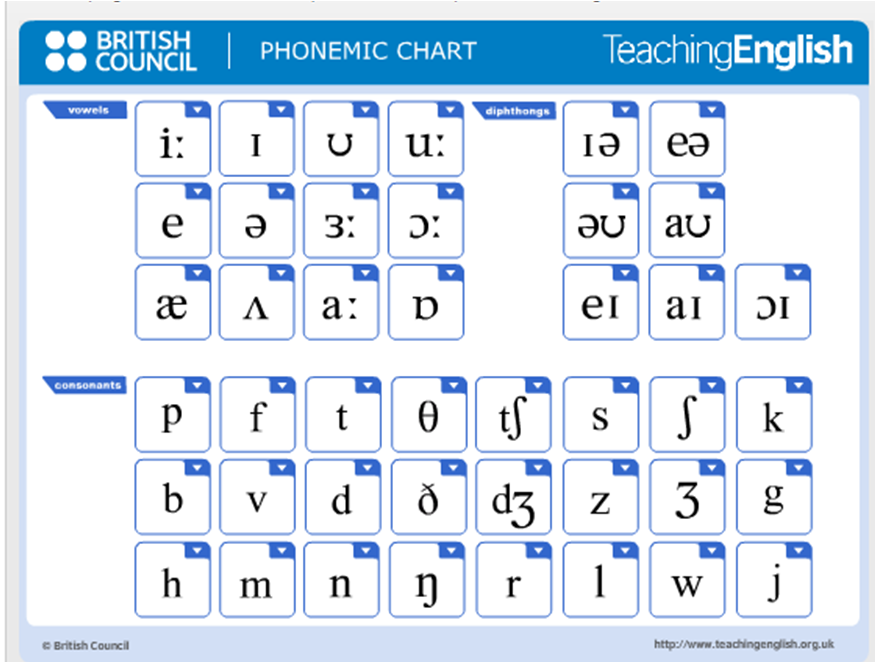
Put
six or so symbols on the board.
Write
words on cards big enough to be seen when stuck on the board. Five for each
sound is enough.
Drill
the sounds. Be imaginative with your voice if doing it with young learners.
They will remember it better if they are having fun.
Put
the students in teams. One person from each team races to the teacher and is
given a card. They return to the group and decide which phoneme is used in the
word from the board. They write the phoneme on the back of the card and run
back to the teacher. If the symbol is correct the student is given another
card. They must keep the cards and try to accumulate as many as possible. The
winning team is the one with the most cards at the end.
Give
the students blu tack and ask them to stick the symbols to the board. Then do
another drilling session.
Then,
in the teams, the students choose two symbols and race to make a sentence for
each that includes three of the words from that symbol. The sentence must make
some sense!
Then
you can reward the most imaginative sentences;
- Chinese whispers
The
teacher sits the learners in a circle and shows a student a symbol, also
whispering it in their ear.
The
sound is passed around the class. If the sound is correct at the end for the
symbol the students get a point, if not the teacher gets a point;
- Using dictionaries
Choose
five words from the dictionary and write them in phonetic script.
Ask
the students in pairs to write down what they think the word is.
Then
get the students to swap papers with a different group and ask them to look up
the word to see if they were correct.
The
winners are the group with most correct;
- Give your learners cards with separate letters on them. How many words can they make from them?
You can divide the class into teams, then pronounce the word (for example, "[k æ t] = cat") and each team is to make a word out of the cards. The team that does it correctly gets a point.

No comments:
Post a Comment